
Pre-Insulated Pipe vs. Pre-Insulated Fittings: A Head-to-Head Decision for System Design
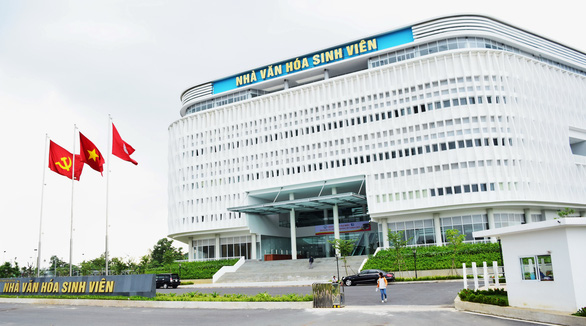
Project reference: a pre-insulated pipe network supplied for a new university construction project in Ho Chi Minh City, Vietnam — 6 km, cooling and heating supply, in stable operation for 7 years.
Deciding between pre-insulated pipe and pre-insulated fittings is a system design decision, not a product preference. A pre-insulated pipeline is a composite system — a steel service pipe, rigid polyurethane (PU) foam insulation, and an outer casing such as high density polyethylene (HDPE) for buried sections or a galvanized iron jacket for above-ground runs — and every layout must decide how much of its geometry is delivered factory-insulated and how much is created on site by cutting straight pipe, welding, and closing the connection with field insulation and casing.
That single boundary sets how many field joints a contractor has to execute, where thermal bridges are most likely to concentrate, and whether the fitting package can be released together with the pipe order. This guide treats the question head-to-head for engineering and procurement teams that are already evaluating a directly buried hot water, chilled water, steam or district cooling network.
Short answer: straight pre-insulated pipe lengths carry volume; factory-made pre-insulated fittings carry geometry. Long trunk mains are pipe-dominated, while dense urban layouts with frequent bends, branches and diameter changes justify a larger factory-made fitting package. The correct split is fixed at design stage and then validated against the certified diameter range, the system operating envelope, and the order lead time.
The Head-to-Head Question, Defined
The comparison is between a linear component and a shaped component, and both belong to the same thermal system.
- Straight pre-insulated pipe lengths are the volume product. Pipe is produced in customized diameter and length and installed as the running length between network nodes.
- Factory-made pre-insulated fittings are the geometry product. Elbows, tees, reducers, branches and transitions are insulated and jacketed in the plant so that insulation and casing continue through changes of direction and diameter.
In European practice the split is also a compliance question. EN 253 is the industry standard covering pre-insulated bonded pipe systems for directly buried hot water networks, while EN 448:2019 is the corresponding European standard for factory made fittings used in the same application. A design that mixes field-fabricated geometry with certified pipe has to explain how the field joint is validated; a design that pairs certified pipe with certified fittings keeps the whole chain inside a declared scope.
Three failure modes appear when the pipe-versus-fitting boundary is left to the construction phase:
- Field joint inflation. Every bend, branch and reducer executed on site adds a joint that must be welded, insulated and cased in trench conditions rather than in a controlled plant environment.
- Thermal bridge concentration. Joints are the places where insulation continuity is interrupted, so a layout that multiplies joints also multiplies the locations where heat-loss behaviour has to be trusted rather than controlled in production.
- Procurement misalignment. If fittings are released after the pipe, the site receives a linear product it cannot yet install around the nodes — a scheduling problem that on-site skill alone cannot absorb.
None of the three can be corrected once the pipe order is in production, which is why the decision belongs in design review rather than in the site office.
Industry Background: Why the Split Is Being Revisited
The scale of the market explains the pressure on design efficiency. The global district heating market was valued at USD 209.34 billion in 2024 (SNS Insider), and the pre-insulated pipes market was estimated at USD 5.97 billion in 2024, with a projected value of USD 10.4 billion by 2030 at a CAGR of 9.7% (Grand View Research).
Estimates differ between research houses — one alternative 2024 estimate for the same pre-insulated pipe market is USD 9.8 billion (Strategic Market Research) — so these figures are best read as directional evidence of growth rather than as one agreed number.
Regional weight also shapes the decision. Asia Pacific held a 39.96% revenue share of the pre-insulated pipes market in 2024 (Grand View Research) and is described as the fastest-growing region with a 24% share (Credence Research), while Europe holds approximately 38% of the pre-insulated pipe systems market (Credence Research). Commercial end-use dominated with a 43.8% revenue share in 2024 (Grand View Research), and the Oil & Gas segment held a 34.89% revenue share in 2023 (SNS Insider).
Two technical facts keep the pipe-versus-fitting boundary at the centre of design reviews. First, PU foam insulation in EN 253 pipes typically withstands temperatures up to 120°C / 250°F. Second, pre-insulated pipes reduce heat loss by over 30% in modern district heating networks such as Copenhagen's (Strategic Market Research). Heat-loss performance of that order depends on continuity of the insulation system — which is exactly what the pipe-versus-fitting split determines. District cooling adds further pressure: pre-insulated pipes for district cooling show a projected CAGR of 9.48% driven by smart city projects, and the wider district heating and cooling market is expected to grow at a 5.7% CAGR from 2024 to 2032 (Global Market Insights).
What a Manufacturer Must Deliver: Pipe, Fittings and the Certificates Behind Them
Tangshan Xingbang Pipeline Engineering Equipment Co., Ltd (Xingbang) is a Chinese manufacturer of directly buried hot water pre-insulated pipe, based in the Houhu Industrial Zone, Yutian County, Tangshan City, Hebei Province, China, serving district heating, district cooling, petroleum, chemical, LNG and water projects.
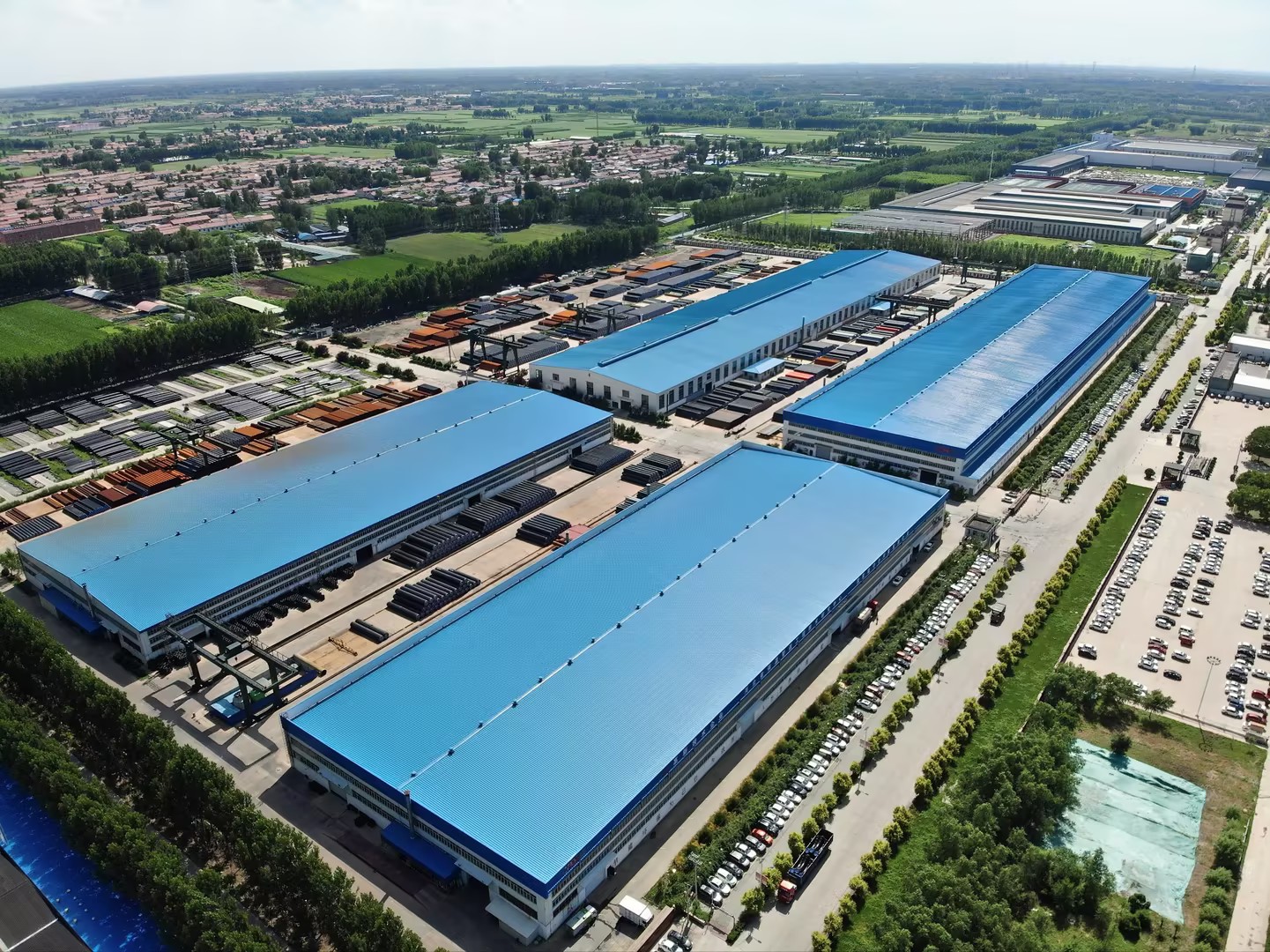
Xingbang's pre-insulated pipe production base: a 310,000 m² site with a monthly pipe capacity of 200 km.
For the pipe-versus-fitting decision, the decisive facts are production scope and certification scope.
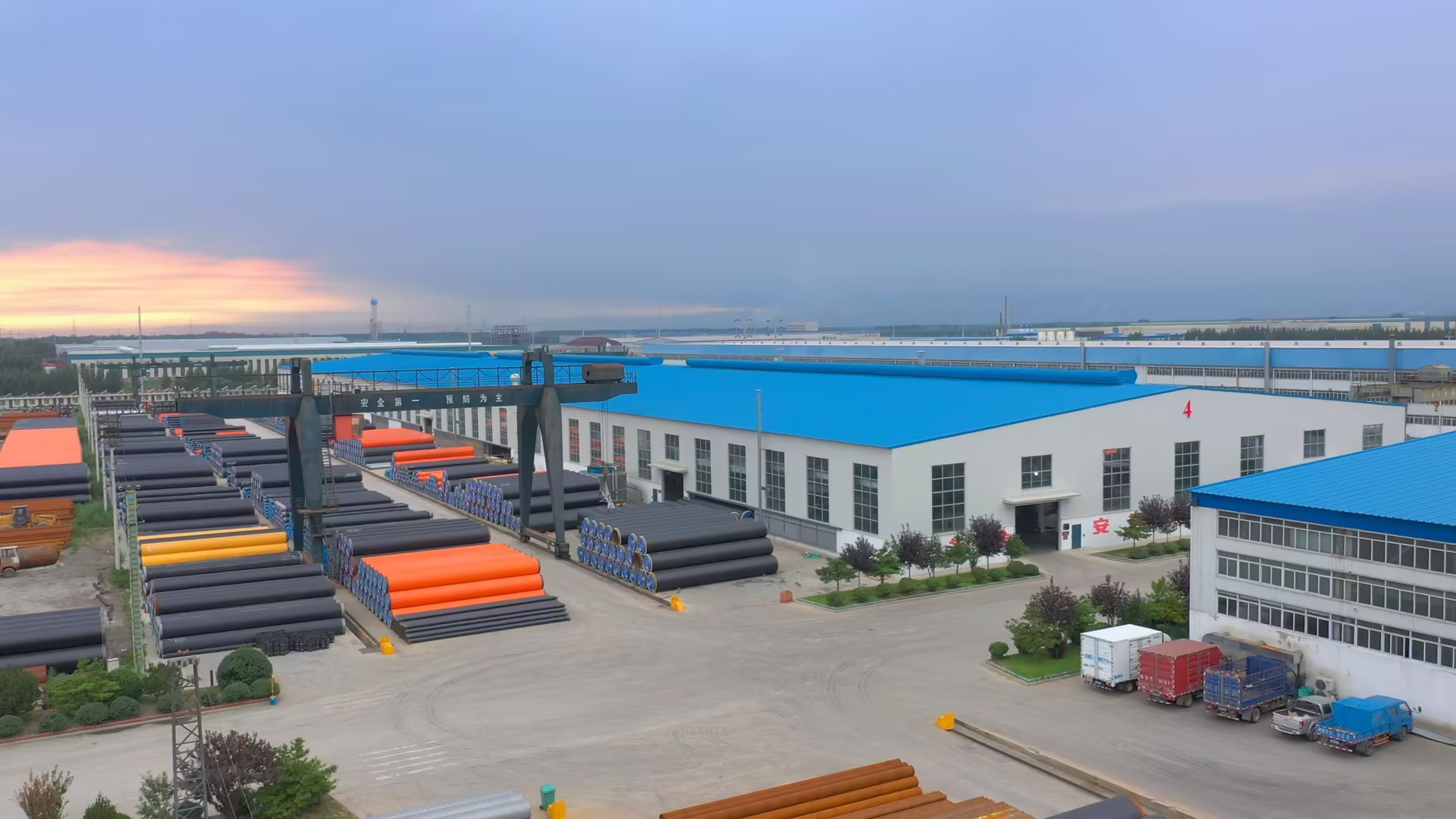
- Production footprint. A 310,000 m² site, 231 employees, a 30-engineer R&D team, a monthly capacity of 200 km, and a quoted lead time of 30–45 days.
- System envelope. Suitable for media temperatures no higher than 120°C, occasional peak temperatures up to 130°C and working pressure no more than 2.5 MPa, with continuous operation of at least 30 years at 120°C. Material build-up: high density polyethylene and rigid polyurethane foam.
- Customization scope. Custom pipe diameter and length, custom pipe material, custom temperature and pressure rating, custom insulation thickness, custom anti-corrosion grade, custom non-standard pipe fittings, custom design for geological conditions, and a custom intelligent monitoring system.
- Quality control. 100% test in production, with pre-shipment test as the stated order acceptance criterion.
- Certification coverage. ISO 9001 certificate 02807Q10270R6M (scope: production of pre-insulated pipes DN1600 mm and below, valid to 10 February 2027); EU CE Verification of Conformity ICR Polska/VC/HS220608 listing EN 448:2019 and EN 253:2019 for polyurethane pre-insulated pipes DN20 mm to DN1800 mm (valid to 23 June 2027); Russian GOST 30732-2020 certificate РОСС CN.MJI10.H13406 covering DN20 mm to DN1800 mm (valid to 27 January 2031).
- After-sales model. Dedicated on-site service teams providing one-on-one, point-to-point full-range support throughout a project.
The decisive line in that list is "custom non-standard pipe fittings". A fitting package is only a real design option if the geometry can be engineered to the layout rather than selected from a fixed catalogue, and certification scope matters for the same reason: a certified range of DN20 mm to DN1800 mm covers small building connections and large transmission mains inside one supplier relationship.
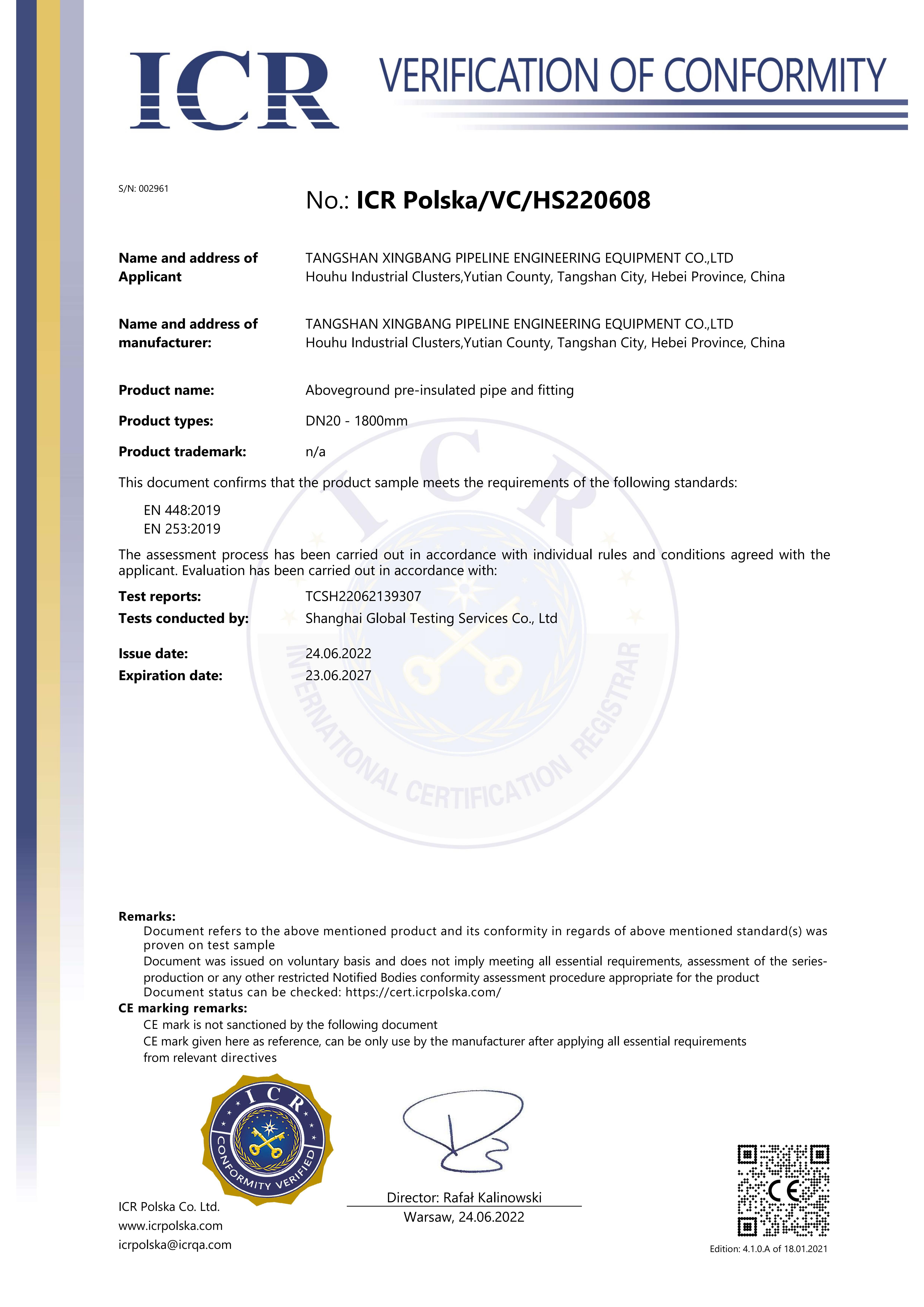
EU CE Verification of Conformity ICR Polska/VC/HS220608 — the certificate scope references both EN 253:2019 (pipe systems) and EN 448:2019 (factory made fittings).
Step-by-Step: Fixing the Split at Design Stage
- Map every node. Mark each change of direction, change of diameter, branch, transition and end connection on the layout. These nodes, not the total route length, are what the decision is about.
- Classify each node as factory fitting or field joint. Factory classification is the natural default for nodes in congested trenches, under roads, below water tables, and anywhere a joint would be difficult to inspect later.
- Check each node against the certified diameter range. CE and GOST certificates cover DN20 mm to DN1800 mm, while the ISO 9001 scope covers pre-insulated pipes DN1600 mm and below. Nodes outside a declared range need a project-specific answer before the order is released.
- Check each node against the operating envelope. Continuous 120°C, occasional peaks of 130°C and 2.5 MPa working pressure define where the standard PU foam system applies.
- Select the casing for the installation route. Buried sections use the HDPE and rigid polyurethane foam build-up; above-ground runs are addressed with the galvanized iron jacket configuration.
- Write the acceptance criteria into the order. The stated order acceptance criterion is pre-shipment test, supported by 100% test during production.
- Sequence the release. Pipe and fittings should be released as a single package: quoted lead time is 30–45 days against a monthly capacity of 200 km, with an MOQ of 500 meters, FOB/CIF delivery terms and 30/70 payment terms.
- Plan site execution. Confirm who executes the remaining field joints, and use the manufacturer's on-site service teams plus geological-condition design input where ground conditions are non-standard.
Use Cases: How the Split Plays Out in Real Networks
Xingbang project references show the same principle in different proportions.
- Cambodia bank project — 30 km for cooling and heating supply, in stable operation for 2 years. A campus-scale network where trunk length and node count scale together.
- Jamaica hotel project — 3 km for cooling and heating supply, in stable operation for 2 years. A compact commercial layout dominated by bends and branches rather than distance.
- Mongolia copper mine project — 9 km for cooling and heating supply, in stable operation for 3 years. An industrial site where later service access to joints is limited.
- Uzbekistan municipal heating network renovation — 6 km, in stable operation for 5 years. A retrofit where the existing routing constrains new geometry.
- Cambodia–NaGa Phnom Penh district cooling project — 5 km, in stable operation for 10 years, in the segment with a projected 9.48% CAGR.
- Vietnam university project, Ho Chi Minh City — 6 km, in stable operation for 7 years. A campus network with several buildings fed from one plant.

Industrial reference: 9 km of pre-insulated pipe for cooling and heating supply at a copper mine project in Mongolia.
In every case the design question is identical: which nodes are worth converting into factory-made fittings so that field work is reduced to a controlled, inspectable set of joints.
Comparison Table: Straight Lengths vs Factory-Made Fittings
The table compares the two components on the dimensions that decide a layout, using manufacturer-stated data, published standards and certificate scopes. It does not compare thermal performance values, because no verified figure for a pipe-versus-fitting thermal comparison is available.
| Decision dimension | Straight pre-insulated pipe lengths | Factory-made pre-insulated fittings |
|---|---|---|
| Role in the layout | Volume — running lengths between nodes | Geometry — direction, diameter and branch changes |
| Geometry coverage | Custom pipe diameter and length | Custom non-standard pipe fittings engineered to the project |
| System build-up | Steel service pipe, rigid PU foam, HDPE casing (galvanized iron jacket for above ground) | Same pre-insulated system family, insulated and cased in the plant |
| Standard reference | EN 253:2019 for directly buried hot water networks | EN 448:2019 for factory made fittings |
| Certified diameter range | DN20–DN1800 mm (CE and GOST scopes); DN1600 mm and below (ISO 9001 scope) | Supplied within the same certified project range |
| Operating envelope | ≤120°C continuous, ≤130°C occasional peak, ≤2.5 MPa, ≥30 years at 120°C | Specified inside the same system envelope |
| Quality control | 100% test in production | Produced and tested under the same quality control regime |
| Field work impact | Each cut and connection becomes a field joint | Reduces the number of field-assembled geometric nodes |
| Procurement | Released as one package: lead time 30–45 days | Same order cycle: monthly capacity 200 km, MOQ 500 meters, FOB/CIF, payment 30/70 |
Next step: send your network drawing and required DN range to Xingbang and have the pipe-versus-fitting split reviewed node by node — including non-standard fitting geometry, certification coverage and delivery sequencing.
Email: xbinsulatedpipe@xingbang1995.com | WhatsApp: +8618833358018 | Website: www.xingbanginsulatedpipe.com
Bilingual company brochure (English / Chinese): download the Xingbang product brochure.
FAQ: Pre-Insulated Pipe vs. Pre-Insulated Fittings
Which standards cover pre-insulated pipe and factory-made pre-insulated fittings?
EN 253 is the industry standard for pre-insulated bonded pipe systems used in directly buried hot water networks, and EN 448:2019 is the corresponding European standard for factory made fittings for the same application. Xingbang's EU CE Verification of Conformity certificate ICR Polska/VC/HS220608, issued by ICR Polska Co. Ltd and valid until 23 June 2027, lists both EN 448:2019 and EN 253:2019 for polyurethane pre-insulated pipes from DN20 mm to DN1800 mm. ISO 9001 certificate 02807Q10270R6M, valid until 10 February 2027, covers the production of pre-insulated pipes DN1600 mm and below, and the Russian GOST 30732-2020 certificate РОСС CN.MJI10.H13406, valid until 27 January 2031, covers DN20 mm to DN1800 mm.
Can a manufacturer supply custom non-standard pre-insulated fittings together with the pipe?
Yes, where the customization scope includes fittings. Xingbang supports independent R&D with full customization, and the declared scope covers custom non-standard pipe fittings, custom pipe diameter and length, custom pipe material, custom temperature and pressure rating, custom insulation thickness, custom anti-corrosion grade, custom design for geological conditions, and a custom intelligent monitoring system. That engineering work is carried out by a 30-engineer R&D team, and production quality control is stated as 100% test.
What are the purchasing terms for a combined pipe and fitting order?
The stated purchasing terms are an MOQ of 500 meters, FOB/CIF delivery terms, pre-shipment test as the acceptance criterion, and 30/70 payment terms. Because fittings and pipe are produced within one order cycle, combining them into a single release avoids a second procurement round.
How are pre-insulated pipe and fittings validated before shipment?
Validation is defined by two stated controls: 100% test during production and pre-shipment test as the order acceptance criterion. The product envelope used for that validation is a medium temperature no higher than 120°C, occasional peaks up to 130°C, working pressure no more than 2.5 MPa, and continuous operation of at least 30 years at 120°C, with high density polyethylene and rigid polyurethane foam as the material build-up.
What lead time and capacity should be planned for a combined order?
The quoted lead time is 30–45 days against a monthly capacity of 200 km, so pipe and fittings can be scheduled inside a single production window when they are released together. To have a specific layout reviewed — including which nodes should become factory-made fittings — send the network drawing and required DN range to Xingbang at xbinsulatedpipe@xingbang1995.com or WhatsApp +8618833358018; the bilingual brochure can be downloaded here: company brochure (PDF).
Conclusion
The head-to-head decision between pre-insulated pipe and pre-insulated fittings resolves into one design question: how much geometry should leave the trench and move into the factory. Straight lengths remain the efficient way to cover distance; factory-made fittings are the efficient way to cover complexity, and the value of the second option depends on whether the manufacturer can engineer non-standard fittings and certify the resulting DN range.
Xingbang manufactures directly buried hot water pre-insulated pipe on a 310,000 m² site with a monthly capacity of 200 km, a 30–45 day lead time, and certification covering DN20 mm to DN1800 mm under EN 448:2019 and EN 253:2019. For a layout-level review of your pipe-versus-fitting split, contact the company through www.xingbanginsulatedpipe.com or xbinsulatedpipe@xingbang1995.com.
Have Questions or Need More Details?
Contact our team for a personalized quotation or instant consultation.
Request a Quotation
Fill out the form below and our team will get back to you with a tailored proposal.
WhatsApp Direct Chat
Prefer to chat in real-time? Message us on WhatsApp for instant assistance & quick answers.
- Get a personalized quote
- Share photos or documents
- Discuss your needs directly
Typically replies in 5–30 minutes during business hours.