
Pre-Insulated Pipe Procurement: Terms-First vs Acceptance-Criteria-First
Short answer: A Pre Insulated Pipe purchase can be sequenced in two ways. A terms-first path fixes the commercial and technical terms — diameter, quantity, price basis, delivery and payment — before acceptance criteria are formalised. An acceptance-criteria-first path fixes the governing standard, certificate scope, inspection points and documentation requirements before the commercial negotiation closes. Terms-first fits projects where cost and schedule certainty dominate and the ordered diameter already sits inside the supplier's certified scope. Acceptance-criteria-first fits projects where inspection planning, regulated network approval or supplier qualification is the dominant risk.
1. Problem Definition: Why the Sequence Decides the Outcome
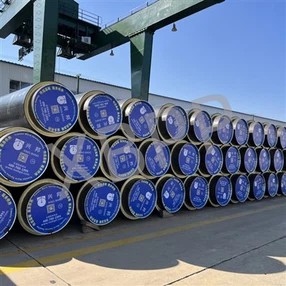
Two buyers can order the same Directly Buried Hot Water Pre Insulated Pipe and receive the same physical product, yet one ends up with a clean delivery and the other with a dispute over inspection paperwork. The product is rarely the variable. The sequence of the purchase is.
Purchasing terms and acceptance criteria are normally written by different functions at different times. Procurement drafts the terms sheet: scope of supply, nominal diameter, quantity, price basis, delivery schedule, payment terms. Engineering and QA-QC draft the acceptance criteria: governing standard, certified diameter range, test regime, joint system requirements, document register. When these two documents are written in the wrong order, three failure modes appear:
- Terms-first, inspection added late. Price and delivery are frozen, then the inspection plan demands tighter documentation than the supplier anticipated. The supplier treats the additional documentation and testing as a variation, and the commercial certainty that terms-first was supposed to deliver disappears.
- Acceptance-criteria-first, supplier pool too narrow. Inspection requirements are written before the commercial envelope is understood. The result is a specification that only a small number of suppliers can meet economically, which weakens the buyer's negotiating position and can delay order release.
- Certificate scope mismatch. This is the hardest failure mode in this category. A supplier may hold valid certification for a diameter range that does not include the DN actually ordered. Pre-insulated pipe certifications are granted against diameter ranges — for example DN20 mm to DN1800 mm — so a certificate on file is not the same as coverage for the ordered item.
The practical decision rule is straightforward: sequence the purchase around the dominant risk, not around the internal document that happens to be easier to write first.
2. Industry Background: Why Documentation Pressure Is Rising
The commercial scale of the sector explains why procurement documentation has become more formal. The global district heating market was valued at USD 209.34 billion in 2024 according to SNS Insider. Other research houses place the same market lower — P&S Intelligence estimates USD 178 billion — largely because scope definitions differ on whether cooling and services are included. That divergence is itself a procurement lesson: a terms document that does not define system scope explicitly will be interpreted differently by different parties.
The pre-insulated pipe segment specifically was estimated at USD 5.97 billion globally in 2024 by Grand View Research, with a projected value of USD 10.4 billion by 2030 and a compound annual growth rate of 9.7%. Growth of this scale increases cross-border sourcing, and cross-border sourcing increases the number of standards a buyer must reconcile in one purchase:
- EN 253 is the industry standard for pre-insulated bonded pipe systems for directly buried hot water networks.
- ГОСТ 30732-2020 is the governing document for pre-insulated pipe supplied into the Russian Federation.
- ASTM A53 is a primary American standard for seamless and welded black and hot-dipped galvanized steel pipe, which is relevant when the service pipe material is specified to a US standard.
- GB/T 19001—2016 / ISO 9001:2015 is the quality management reference used to assess how a factory controls production.
There is also a physical boundary that shapes every acceptance criterion. Polyurethane foam insulation for EN 253 pipes typically withstands temperatures up to 120°C (250°F). Any acceptance criterion written above that envelope changes the product class, not just the inspection level — which is precisely why the operating envelope belongs in whichever document is locked first.
3. The Two Sequences, Defined
3.1 Terms-first sequencing
Terms-first means the commercial and technical envelope is agreed and signed before the acceptance and inspection plan is finalised. The buyer locks diameter, quantity, unit, delivery basis, payment schedule and the commercial consequence of delay or rejection, then adapts the inspection plan to the selected supplier's certified scope. The advantage is speed and price certainty; the exposure is that inspection requirements may be priced as changes rather than included in the base offer.
3.2 Acceptance-criteria-first sequencing
Acceptance-criteria-first means the inspection and documentation framework is fixed first: governing standard, certified diameter range, test regime, joint materials, document register and the evidence required at each hold point. Commercial terms are then negotiated inside that framework. The advantage is that rejection risk and documentation gaps are addressed before money is committed; the exposure is a longer pre-award phase and a narrower supplier list.
3.3 What each document actually contains
Purchasing terms for a pre-insulated pipe order normally cover: scope of supply, pipe type and configuration, material build, nominal diameter and wall thickness, quantity and unit of measure, price basis, delivery and shipping terms, payment schedule, minimum order quantity, production lead time and after-sales obligations. For Xingbang, the production-side boundary conditions that sit inside these terms are a monthly capacity of 200 km, a minimum order quantity of 1 km and a lead time of 30–45 days.
Acceptance criteria cover the evidence that the delivered pipe matches the specification: the governing standard, the certificate number and the diameter range it covers, the operating envelope, material verification, joint system materials, testing and the document set released before shipment.
| System layer | What the acceptance criteria should specify | Evidence the supplier should submit |
|---|---|---|
| Service pipe | Steel grade and standard reference, nominal diameter and wall thickness, surface condition | Material certificate and dimensional record |
| Insulation | Rigid polyurethane foam, continuous service at 120°C, occasional peak not exceeding 130°C, working pressure not exceeding 2.5 MPa, minimum 30-year continuous operation at 120°C | Compliance statement referenced to the ordered diameter range |
| Outer casing | High Density Polyethylene jacket: material, thickness, jointing method | Material declaration and casing data |
| Joints and fittings | Electrofusion sleeve, heat shrinkable sleeve, insulation joint material, foaming filler, sealing and waterproof material | Joint material list and jointing procedure |
| Certification | Certificate number, issuing authority, standard reference, certified diameter range, issue and expiry dates | Certificate copies with scope confirmed against the ordered DN |
| Testing | Test coverage per unit before shipment | Test record confirming 100% test coverage |
4. Side-by-Side Comparison
| Comparison dimension | Terms-first path | Acceptance-criteria-first path |
|---|---|---|
| Document locked first | Commercial and technical terms sheet | Inspection and test plan with document register |
| Primary risk addressed | Cost and schedule certainty | Rejection, rework and documentation gaps at delivery |
| Effect on supplier shortlist | Broader; shortlisting driven by capability and price | Narrower; only suppliers whose certified diameter range covers the ordered DN |
| Change behaviour | Later tightening of acceptance criteria is usually treated as a variation | Later commercial adjustment sits inside a fixed inspection framework |
| Best project profile | Schedule-driven projects, repeat orders, standard DN already inside certified scope | First orders, regulated networks, third-party inspection, non-standard DN or joints |
| Internal owner | Procurement and commercial | Engineering and QA-QC |
| Main failure mode | Acceptance criteria written after price freeze | Inspection plan written before the commercial envelope is understood |
| Lead-time effect | Production lead time of 30–45 days starts earlier | Document review adds time before order release |
5. Decision Matrix: Which Sequence Fits Your Risk
| Dominant procurement risk | Recommended sequence | Reason |
|---|---|---|
| Commercial certainty — fixed budget and fixed installation window | Terms-first | Price basis and delivery schedule are protected, and the inspection plan is adapted afterwards |
| Inspection planning — regulated network or third-party inspection | Acceptance-criteria-first | The hold points, document register and test regime are agreed before money is committed |
| Supplier qualification — new supplier, new region, non-standard DN | Acceptance-criteria-first | Certificate scope is verified against the ordered diameter before commercial negotiation |
| Speed — standard product, repeated configuration | Terms-first | The specification is already proven and the certified scope is already confirmed |
| Mixed risk — some layers critical, others standard | Hybrid: acceptance criteria first for critical layers only | Joints, insulation envelope and certifications are locked; casing and accessories stay commercial |
6. Step-by-Step Breakdown
Step 1 — Fix the operating envelope
Define the medium, the continuous service temperature, the occasional peak temperature and the design working pressure. For a standard PU foam pre-insulated pipe this is a medium temperature of no higher than 120°C, an occasional peak not exceeding 130°C and a working pressure of no more than 2.5 MPa.
Step 2 — Choose the governing standard and confirm the certificate scope
Select the standard that applies to the destination market, then check that the ordered nominal diameter falls inside the certified range, not merely that the supplier holds a certificate.
Step 3 — Decide the sequence based on the decision matrix
Apply the matrix above. If inspection or qualification risk dominates, write acceptance criteria first. If cost and schedule dominate, write terms first.
Step 4 — Map every acceptance criterion to a document
A criterion without a named document is not enforceable. Each line of the inspection plan should point to a specific certificate, test record, material declaration or dimensional record.
Step 5 — Set the commercial boundary conditions
Confirm minimum order quantity, production lead time and monthly capacity against the project schedule so the terms are realistic before signature.
Step 6 — Lock the joint and fitting system
Joints are where directly buried pipelines are most often compromised. Specify electrofusion sleeves, heat shrinkable sleeves, insulation joint material, foaming filler and sealing and waterproof material as one complete jointing package.
Step 7 — Agree the pre-shipment hold point
Define what must be completed before goods leave the factory, including dimensional verification and the test record confirming 100% test coverage.
Step 8 — Define post-delivery obligations
Agree installation support, site service and the handling of any non-conforming item. After-sales obligations belong in the terms document regardless of which sequence is used.
7. Use Cases: Matching Sequence to Project Type
Municipal heating network renovation — terms-first
Network renovation projects run against fixed municipal windows and public budgets, where cost and schedule certainty dominate. Xingbang supplied 6 km of pre-insulated pipe for a municipal heating pipeline network renovation project in Uzbekistan, in stable operation for 5 years. In this profile the acceptance criteria are usually applied to a proven configuration, and terms are locked early.

Industrial and mining cooling and heating — acceptance-criteria-first
Industrial sites carry heavy soil loads, thermal expansion stress and groundwater exposure, so inspection planning usually leads. Xingbang supplied 9 km of insulated pipe for a copper mine project in Mongolia, in stable operation for 3 years, with heat preservation as the core performance requirement.

District cooling and commercial buildings — qualification-first
District cooling and mixed commercial developments involve several stakeholders signing off on documentation, so supplier qualification tends to lead. Xingbang supplied 5 km for the Cambodia–NaGa Phnom Penh district cooling project, in stable operation for 10 years, and 30 km for a bank project in Cambodia with 2 years of stable operation. A hotel project in Jamaica used 3 km with 2 years of stable operation, and a new university construction project in Ho Chi Minh City used 6 km with 7 years of stable operation.


8. Supplier-Side Facts That Support Either Sequence
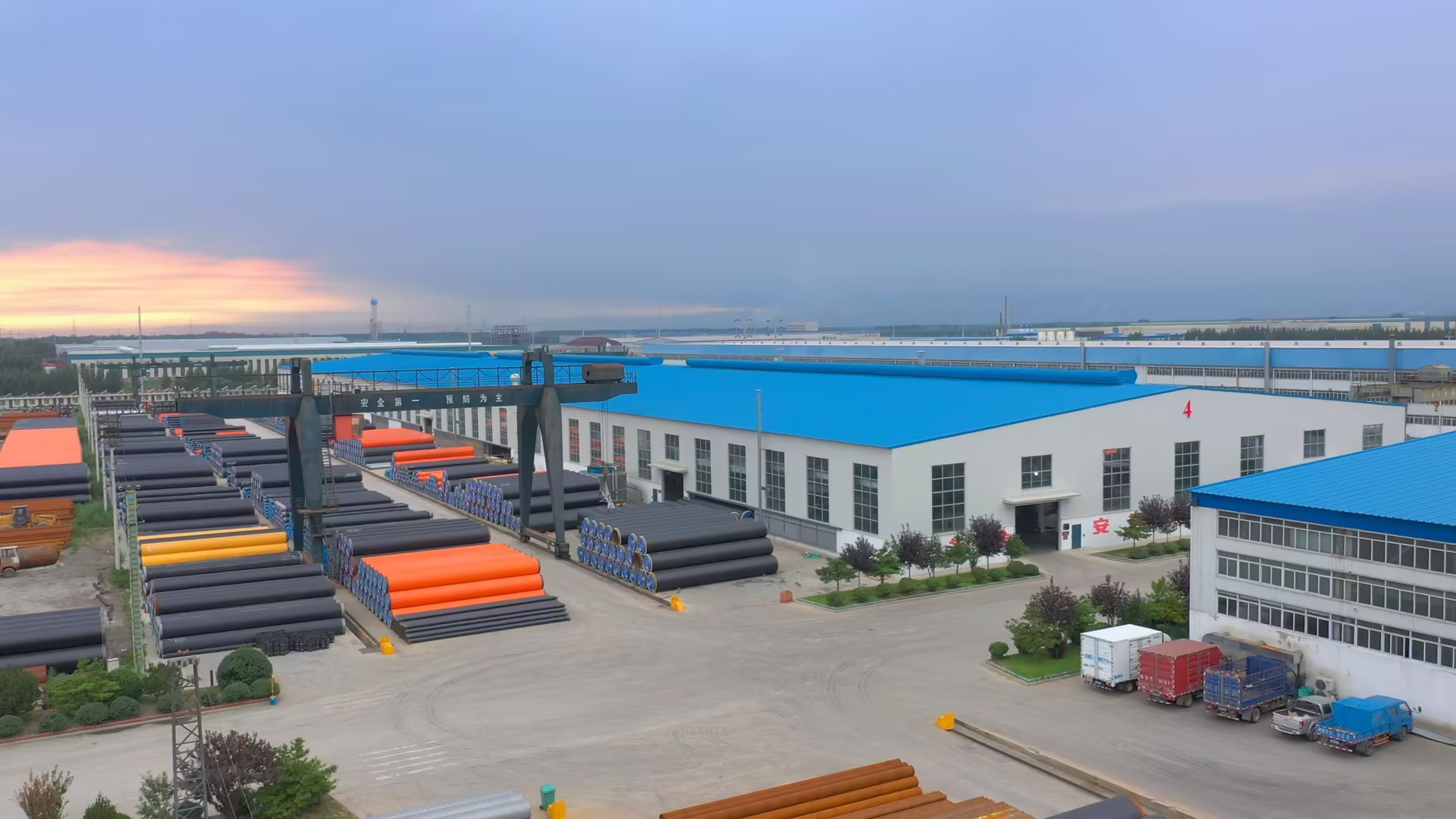
Tangshan Xingbang Pipeline Engineering Equipment Co., Ltd is a pre-insulated pipe manufacturer located in Houhu Industrial Park, Yutian Economic Development Zone, Hebei Province, China. The company operates a 310,000 m² facility with 231 employees, including a 30-engineer R&D team, and exports to Europe, North America and the Middle East, representing 30% of its business. It is a participant in the formulation of the Chinese national standard for directly buried insulation pipes and a national green design demonstration enterprise.
For buyers using a terms-first sequence, the relevant boundary conditions are a monthly capacity of 200 km, a minimum order quantity of 1 km and a production lead time of 30–45 days. For buyers using an acceptance-criteria-first sequence, the relevant evidence set is documented in three certifications, each with a defined scope:
| Certificate | Number | Standard | Scope | Validity |
|---|---|---|---|---|
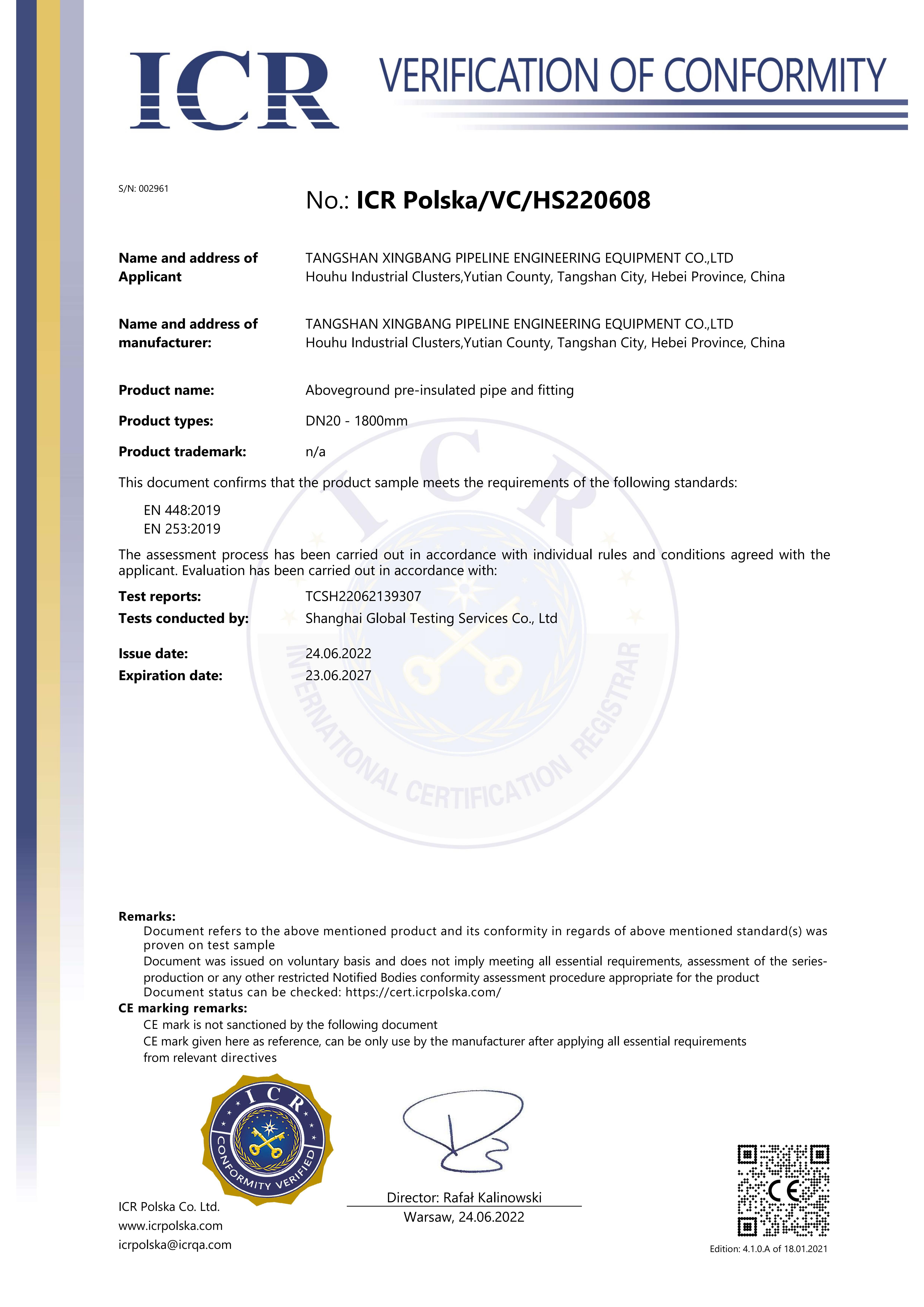
| EU CE Verification of Conformity | ICR Polska/VC/HS220608 | EN 448:2019; EN 253:2019 | Polyurethane pre-insulated pipes DN20 mm – DN1800 mm | Issued 24 June 2022, valid to 23 June 2027 |
| Russian Federation certificate of conformity | РОСС CN.MJI10.H13406 | ГОСТ 30732-2020 | DN20 mm – DN1800 mm | Issued 28 January 2026, valid to 27 January 2031 |
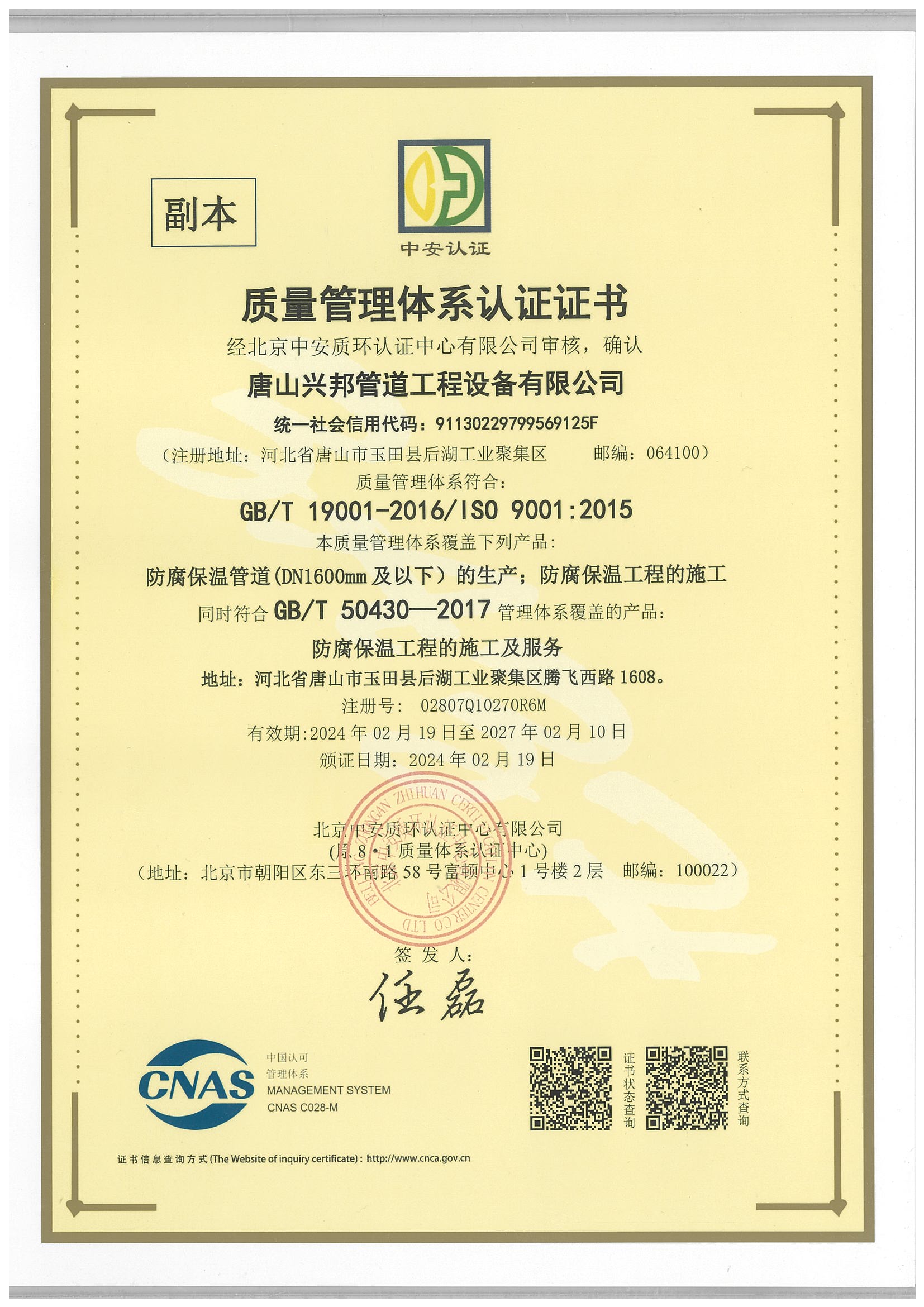
| ISO 9001 Quality Management System | 02807Q10270R6M | GB/T 19001—2016 / ISO 9001:2015 | Production of pre-insulated pipes DN1600 mm and below; pipeline insulation project construction | Issued 19 February 2024, valid to 10 February 2027 |
The EU CE certificate was issued by ICR Polska Co. Ltd, the Russian certificate by Эрри-тест, and the ISO 9001 certificate by Beijing Zhong'an Quality & Environment Certification Center Co., Ltd. Customization capability covers pipe diameter and length, pipe material, temperature and pressure rating, insulation thickness, anti-corrosion grade, non-standard pipe fittings, design for geological conditions and intelligent monitoring systems.
9. FAQ
Which standards and certificates should be written into the acceptance criteria for a directly buried hot water pre-insulated pipe?
For directly buried hot water networks, EN 253 is the industry standard for pre-insulated bonded pipe systems. A practical acceptance section references the standard, the certificate number, the issuing authority, the certified diameter range and the expiry date. For example, Xingbang holds EU CE verification of conformity ICR Polska/VC/HS220608, issued by ICR Polska Co. Ltd, covering polyurethane pre-insulated pipes from DN20 mm to DN1800 mm against EN 448:2019 and EN 253:2019. For supply into the Russian Federation, certificate РОСС CN.MJI10.H13406 covers DN20 mm to DN1800 mm against ГОСТ 30732-2020. Buyers should copy the scope wording and validity dates directly into the purchase order rather than referring to the certificate generally.
How do you qualify an EN 253 pre insulated district heating pipe manufacturer?
Qualification starts with documents and moves to capability. Ask for the certificate number, issuing body, standard reference and the diameter range covered, then confirm that the ordered nominal diameter sits inside that range. Next, check the quality management scope: Xingbang's ISO 9001 certificate 02807Q10270R6M, issued by Beijing Zhong'an Quality & Environment Certification Center Co., Ltd and valid to 10 February 2027, covers production of pre-insulated pipes DN1600 mm and below and pipeline insulation project construction. Finally, confirm the inspection regime — Xingbang applies 100% test coverage — and the factory's production capacity relative to the project schedule.
What commercial terms should be fixed before order release on a pre-insulated pipe purchase?
The terms sheet should state scope of supply, pipe configuration, nominal diameter, quantity, price basis, delivery basis, payment schedule, minimum order quantity and production lead time. For reference, Xingbang's standard boundary conditions are a minimum order quantity of 1 km, a production lead time of 30–45 days and a monthly capacity of 200 km. The customization scope should also be listed in the terms, because diameter and length, pipe material, temperature and pressure rating, insulation thickness, anti-corrosion grade, non-standard fittings, geological-condition design and intelligent monitoring all affect commercial outcome.
What should acceptance cover before the goods leave the factory?
Pre-shipment acceptance should cover dimensional verification against the ordered diameter and length, confirmation that the material build matches the specification of High Density Polyethylene casing and rigid polyurethane foam insulation, the joint material package — electrofusion sleeve, heat shrinkable sleeve, insulation joint material, foaming filler and sealing and waterproof material — and a test record. Xingbang applies 100% test coverage as standard, which means the corresponding test documentation is part of the release package.
When should acceptance criteria be locked relative to order release?
Locking acceptance criteria before order release removes the most common source of downstream dispute, because the documentation burden is priced and scheduled from the start rather than added as a variation. With a production lead time of 30–45 days, any renegotiation of inspection requirements after release consumes part of the delivery window. Buyers who must move quickly can use a hybrid approach: lock acceptance criteria for the insulation envelope, joints and certification scope, and leave casing accessories and logistics to the commercial annex.
10. Conclusion: Sequence Around the Dominant Risk
Terms-first and acceptance-criteria-first are both defensible procurement sequences for pre-insulated pipe. The deciding factor is which risk would be most expensive to discover late. If the project is schedule-driven, uses a proven configuration and already sits inside a supplier's certified diameter range, locking terms first protects cost and delivery. If the project faces regulated inspection, third-party verification or a first-time supplier, locking acceptance criteria first protects the buyer from rejection, rework and documentation gaps.
Whichever path is chosen, two items must appear in the final order: the governing standard with the certified diameter range that covers the ordered DN, and the operating envelope — continuous service at 120°C, occasional peak not exceeding 130°C, working pressure not exceeding 2.5 MPa, and a service life expectation consistent with continuous operation at 120°C.
Next step
Send your operating envelope and ordered diameter range to Xingbang, and the team will confirm certificate scope, insulation configuration, lead time and delivery terms before you commit to either sequence.
- Website: www.xingbanginsulatedpipe.com
- Email: xbinsulationpipe@xingbang1995.com
- Phone: +86 18331518911 | WhatsApp: +8618833358018
- Download the company brochure with full product and project details: Xingbang company brochure (PDF)
Have Questions or Need More Details?
Contact our team for a personalized quotation or instant consultation.
Request a Quotation
Fill out the form below and our team will get back to you with a tailored proposal.
WhatsApp Direct Chat
Prefer to chat in real-time? Message us on WhatsApp for instant assistance & quick answers.
- Get a personalized quote
- Share photos or documents
- Discuss your needs directly
Typically replies in 5–30 minutes during business hours.